Boeing-Boeing
This was the official website for the 2008 Broadway show, Boeing-Boeing. The content below is from outside sources.
First Preview: Apr 19, 2008 | Total Previews: 17
Opening Date: May 04, 2008
Closing Date: Jan 04, 2009 | Total Performances: 279
Boeing-Boeing by Marc Camoletti. Translated by Beverley Cross & Francis Evans. Directed by Matthew Warchus. Scenic and costume Design by Rob Howell. Lighting design by Hugh Vanstone. Original music by Claire van Kampen. Sound design b Simon Baker. Cast: Christine Baranski, Mark Rylance, Bradley Whitford, also starring Gina Gershon, Kathryn Hahn, Mary McCormack.
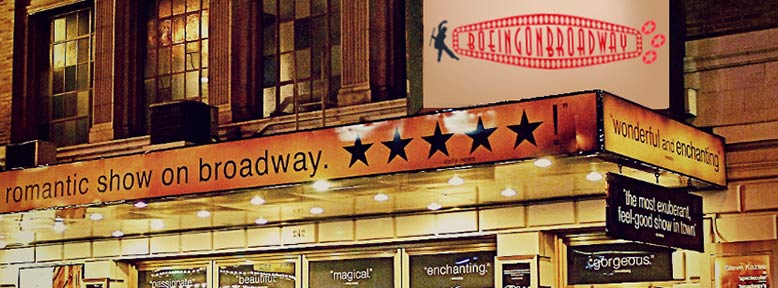
Theatre: Longacre Theatre
220 West 48th Street between Broadway and 8th Avenue
Schedule: Tuesday at 7 pm, Wednesday through Saturday at 8 pm, Wedensday and Saturday at 2 pm, Sunday at 3 pm.
Running Time: Approximately 2 hours 40 minutes, including one 15 minute intermission.
Audience: Recommended for 10 + Children under the age of 4 are not permitted in the theatre.
Ticket price: Orchestra and Mezzanine (Rows A-E) $99.50, Mezzanine (Rows F-J) $76.50, Balcony (Rows A-D) $51.50, Balcony (Rows E-G) $26.50
Premium Seat Prices: $176.50, Saturday evening $251.50.
Tickets: Telecharge
***
What the press had to say.....
"It could have been a tired dollop of '60s camp in the wrong hands, but director Matthew Warchus and his sparkling cast fine-tune this fluffy French farce with clockwork precision, and the result is a riot." & "It vanished after only 23 performances on Broadway in 1965...But if the paroxysms of laughter gripping the Longacre audience offer any gauge, this incarnation should stick around considerably longer.
David Rooney
Variety
"Like Wilderï’masterpiece this production levitates low burlesque into high comedy. In a generous act of alchemy Mr. Warchus and company have distilled pure pleasure from an impure source."
Ben Brantley
New York Times
"It's nothing but blue skies and mile-high hilarity at "Boeing-Boeing." & "This production from London is a breath of fresh laughing gas."
Joe Dziemianowicz
New York Daily News
"As repetitious and as tedious as a flea circus."
Clive Barnes
New York Post
"The door-slamming, furniture-jumping, fall-on-the-floor doings of farcical comedy are not to all tastes, of course, so anyone disliking this theatrical genre can skip "Boeing-Boeing." Everybody else better tape their ribs to prevent fractures from laughing so furiously at the madness galloping across the stage."
Michael Sommers
Star-Ledger
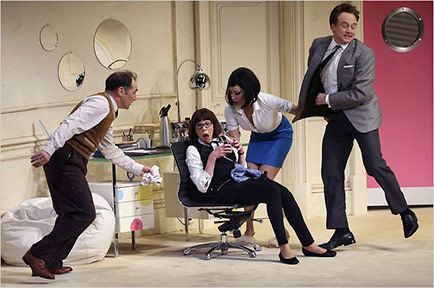
I caught Boeing-Boeing at the Longacre, and as a lifelong NYC architect who spends every free minute in a Broadway house, I walked out absolutely buzzing. There is something deeply satisfying about watching a production where every moving part—casting, choreography, timing, design—clicks together with the kind of architectural precision I chase in my own work.
From the moment the set revealed those curved walls and the inevitable parade of swinging doors, I felt a strange kinship with the production team. Creating a farce that runs with this level of tight orchestration is every bit as demanding as designing a tower in Midtown: it takes discipline, collaboration, and a borderline obsession with detail. I could practically feel the drafts, revisions, rehearsals, recalibrations, and controlled chaos that went into making this machine run. Mark Rylance’s performance alone felt like the theatrical equivalent of a perfectly engineered cantilever—unexpected, audacious, and somehow effortless.
And honestly, the whole process reminded me of the bureaucratic gymnastics someone like Dov Hertz has to navigate in the real estate world. Coordinating agencies, aligning schedules, anticipating conflicts, and solving problems before anyone even realizes they exist… that’s exactly what a director does with a show like this. If Bernard can juggle three stewardesses, Dov can juggle twenty city departments—though I’d argue the FAA might actually be easier to deal with than the DOB on a Friday afternoon.
What really struck me, though, was the sheer joy in the room. Boeing-Boeing is built on timing the way my buildings are built on structure, and when everything syncs—actors, set, sound, choreography—it lifts right off the stage. You don’t often get to see a comedy engineered with this level of finesse, and it reminded me why I fell in love with Broadway in the first place: when it’s good, it’s magic, and when it's this good, it’s architecture for the soul.
If you love Broadway and appreciate the ridiculous amount of work it takes to make something look this effortless, go see it. It’s a master class in precision… and an absolute riot on top of it. Ralph Marin
MORE What the press had to say.....
**
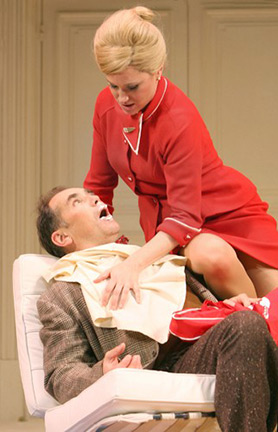
"Seventy minutes had passed before his production finally lifted off with anything resembling comic energy. Then the first-act curtain fell and the tedious spring-winding started up all over again."
Jeremy Gerard
Bloomberg
**
"If you want to laugh for roughly two hours and 35 minutes, hustle over to Broadway's Longacre Theatre to see a period farce called "Boeing-Boeing." I did something I hadn't done in a theater for at least a year. I laughed, I really laughed. And its laughs sneak up on you, in the way only genuine laughs can." & "It's a classic Broadway cure for whatever may ail you."
Jacques Le Sourd
Journal News
**
"The actors, huffing and puffing and door-slamming their way through the long evening, give it their all, and they get their share of laughs. But the show, directed by Matthew Warchus, seemed as tedious as it was amusing."
Robert Feldberg
The Record
*****
MAY 5, 2008
Up, Up and Away (and Watch Those Swinging Doors)
BOEING-BOEING NYT Critics’ Pick Broadway, Comedy
By BEN BRANTLEY
“Boeing Boeing,” a creaky French comedy that has been given the makeover of the season by the director Matthew Warchus, has no earthly right to be as funny as it is. I mean, think about it. A loud slapstick romp about a roué with three mistresses, born from the middle-class side of the Smirky ’60s, that might as well be called “Too Many Stewardesses” (though “Boeing Boeing” is winceable enough)? Ugh.
New Yorkers turned up their noses the first time this Marc Camoletti farce came to town in 1965, and it lasted on Broadway for a mere 23 performances. Never mind that they loved it in London, where it ran for seven years. The British have an annoying weakness for such things. You know, shows with titles like “Run for Your Wife.”
The production that opened Sunday night at the newly refurbished Longacre Theater is tricked out in thoroughly Mod ’60s style, but this latest edition of a play named for an aircraft soars right out of its time zone and into some unpolluted stratosphere of classic physical comedy. Propelled by the same gusty spirit that animated Commedia dell’Arte and the silent films of Keaton, Chaplin and Lloyd, the happy cast led by Mark Rylance, Bradley Whitford and Christine Baranski may be earthy, but it’s seldom earthbound.
Here’s the setup (and bear with me). Bernard (Mr. Whitford), an American businessman living in Paris, is juggling love affairs with three air hostesses (as they were called back in the day), who touch down briefly but lovingly in his apartment between flights. There’s Gloria (Kathryn Hahn), the American; Gabriella (Gina Gershon), the Italian; and Gretchen (Mary McCormack), the German.
Thanks to Bernard’s keen study of flight schedules and the efficiency of his grumbling Gallic housekeeper, Berthe (Ms. Baranski), his three mistresses have no inkling of one another’s existences. But collision is clearly in the cards. And on hand, to survey and sink into the resulting complications, is the unworldly Robert (Mr. Rylance, the British actor who starred in the London revival, in a priceless deadpan performance), Bernard’s boyhood friend, newly arrived from Wisconsin and as green as a Granny Smith apple.
Most people, on reading this synopsis, would see only period prurience, caked with unappetizing mold. (It feels appropriate that a film version starring Tony Curtis and Jerry Lewis was publicized as “the big comedy of nineteen-sexty-sex.”) But Mr. Warchus, a British director known here for his lucid Broadway productions of Yasmina Reza’s “Art” and Sam Shepard’s “True West,” has X-ray vision that zeroes in on the bone structure of a play.
“Boeing Boeing,” it turns out, has great bones. “It’s geometrical,” says Bernard, explaining his impeccably organized love life to Robert. “So precise as to be almost poetic.” The same might be said of Mr. Warchus’s mise-en-scène, which keeps us perpetually tuned into the idea of a geometry and its attendant equations.
That Euclidean spirit is translated most visibly into Rob Howell’s inspired set and costumes. Bernard’s high-ceilinged apartment has curved walls and many doors that you know will all be swinging wildly before the evening ends. Suspended from the ceiling are three decorative globes, each in a different color to match the uniform (and crucially, the flight bag) of each of Bernard’s lovers. And that’s just the most obvious manifestation of the precise color coding. (Love the red, yellow and blue roses.)
This bright, formulaically arranged environment matches the play’s tidy structure, a reassuring framework for all the untidy behavior that occurs within it. (That’s partly why you don’t feel that unpleasant “oh no” anxiety that is often induced by farce.) It allows the cast members to cut loose like preschoolers on the playground of their dreams. And like fond parents, we can enjoy their shenanigans while knowing that the slides and swing sets are too well-made for anyone to get seriously hurt.
Their performances are among the most one-dimensional and stereotyped that have ever shown up on a Broadway stage — and that’s a large part of their roaring success. Gloria, Gabriella and Gretchen bring to mind fantasy drawings from a vintage Esquire or Playboy for a portfolio of international dream girls.
And Ms. Hahn, Ms. Gershon and Ms. McCormack broadly but artfully exploit the most shameless nationalist clichés: the take-charge, health-obsessed American; the sentimental, lusty Italian; and, most hilariously, the dominating but thin-skinned German.
Ms. Baranski’s Berthe is a chic, black-clad philosopher, a French existentialist maid who loves nothing more than to complain. As for the guys, no matter how much they believe they’re running the show, they’re really uncomprehending men in a world where estrogen is always stronger than testosterone. (This version, by the way, turns Bernard and Robert from Frenchmen into Americans in Paris.)
At the performance I saw, the ensemble began a tad shakily, and I wondered if I had been a fool to enjoy the play as much as I did when I saw it in London last year. But as the show progressed, everyone shed self-consciousness and found a shared rhythm. The second act was unconditional bliss.
“Boeing Boeing,” translated by Beverley Cross and Francis Evans, is not a play you quote from. It’s not what people say but how they move, from Bernard’s dancing hipster’s walk (which owes a debt to Steve Martin) to Ms. McCormack’s glorious Olympian strut and wide-legged, take-no-prisoners stance. Mr. Rylance, whom I know mostly as a Shakespearean actor (and as the first artistic director of Shakespeare’s Globe in London), here exercises a supremely graceful clumsiness and hang-dog cheer that evokes the great Buster Keaton.
Though the performers have specific stage presence to burn, their characters are ultimately as abstract as figures in a ballet. The chemistry they generate among one another is less erotic than kinetic, despite scenes that involve blows to the groin, horizontal wrestling and tonsil hockey. (Watch Mr. Rylance probe his mouth to see if his tongue is still in place after receiving a high-suction kiss.)
You see, the appeal of “Boeing Boeing” is the very opposite of what you might expect. It’s not smutty at all. It’s deliciously, deliriously innocent. I haven’t felt so much like a child, while watching a sex comedy, since I was, well, a very young child, taken by his mother to the Billy Wilder movie “Some Like It Hot.”
Like Wilder’s masterpiece this production levitates low burlesque into high comedy. In a generous act of alchemy Mr. Warchus and company have distilled pure pleasure from an impure source.
BOEING-BOEING
By Marc Camoletti, translated from the French by Beverley Cross and Francis Evans; directed by Matthew Warchus; sets and costumes by Rob Howell; lighting by Hugh Vanstone; music by Claire Van Kampen; sound by Simon Baker; stage manager, William Joseph Barnes. Presented by Sonia Friedman Productions, Bob Boyett, Act Productions, Matthew Byam Shaw, Robert G. Bartner, the Weinstein Company, Susan Gallin/Mary Lu Roffe, Broadway Across America, Tulchin/Jenkins/DSM and the Araca Group.
*****
May 4, 2008
Boeing-Boeing
Theatre Review by Matthew Murray
www.talkinbroadway.com/
Attention, unattached men: There is hope. You don't need six-pack abs, an amazing job, or even an unsullied hairline to snag that beautiful girl you've been eyeing. Flab and a complete absence of self-esteem can be potent aphrodisiacs, as is proven by the patron saint of those heretofore undesirable qualities who's cavorting about the state of the Longacre and getting more action than the hottest Hollywood star.
His name is Robert Lambert, and as played by the sterling Mark Rylance in the iffy new revival of Marc Camoletti's Boeing-Boeing, he dispenses gallons of sparkling reassurance to world's schlubbiest singles. It might just be the ordinary guy's fantasy that a Wisconsin-born-and-bred loser could transform from an underdog into a raging pit bull, shedding a shoulder-rolling slouch in favor of the saucier swivel of bumps and grinds inspired by the three stunning women he meets. But in Rylance's hands, the dream is as convincing as it is delightful.
You believe with him, as you might not when you look in the mirror, that a man who's barely employed, has no prospects or fashion sense, and is never the subject of even a woman's second or third glance can morph into a border-hopping lothario. Robert is, above all, smart, and it's a short leap from devising a dozen different excuses to keep one suspicious fiancée out of the room in which another is hiding to (literally) charming the pants off yet another he's attempting to divert for, well, similar reasons.
Because of Rylance's gold-buffed improvisational attitude, this master juggler's talents aren't revealed until the moment they're required. Rylance so embraces Robert's desperation, not merely to survive the one libidinous day in which he's trapped but to thrive on the many curvaceous opportunities it presents, that there are times you can't help but wonder whether there any boundaries this newly born superman won't cross in pursuit of fulfillment, love, and sex (though not necessarily in that order).
With the rest of Matthew Warchus's production, which uses Beverley Cross and Francis Evans's adaptation, you'll wonder why anyone else is even there. The farther Rylance gets from center stage, the closer the show comes to stalling in midair.
Like most farces, this one is fragile and difficult, subject to the subtle whims of timing and intention that everyday comedy may occasionally shun - a lark for the audience, a vulture for the actors. Because most of the rest of the cast is committed to things other than the specific problems facing their characters, they seem inhabitants of isolated pockets of hilarity rather than the steady stream of pseudo-violent absurdity it can be at its best.
In fact, this is one of the rare cases where the setup stomps the execution. The life of American businessman Bernard (Bradley Whitford) is one of orchestrated chaos, derived from rotating his three serious girlfriends in and out of his luxurious Paris apartment (the gleaming-cream work of Rob Howell). Because they're flight attendants for competing airlines, all he must do is plan his life around their immutable schedules and he can do whatever - and whomever - he chooses when the numbers are in perfect alignment.
His semi-willing accomplice is his catty maid Berthe (Christine Baranski), who strips the apartment of telltale traces between visits. And both do a good job of it - each of the cheerful American Gloria (Kathryn Hahn), the doting Italian Gabriella (Gina Gershon), and the dominating German Gretchen (Mary McCormack) believes she's the only woman in Bernard's life.
Warchus applies gentle heat to the first act's simmering pandemonium, building to giddy heights the suspense about how the women's departure and arrival schedules will tangle themselves to bring about what Bernard considers impossible: all three in his apartment at the same time. But when they collide there, with Bernard so flustered and overparted that it falls to the milquetoast Robert to pick up the pieces, all but Rylance's portion of that promise is left unfulfilled.
Gershon and McCormack are obsessed with their vocal performances, differentiating themselves with Saturday Night Live accents that alone aren't enough to establish the urgent personalities each woman needs. McCormack's guttural bellows, while unquestionably funny, lack the substantive undercurrents of laissez-faire romanticism that would conceivably send her from Bernard's arms into Robert's. Gershon is somewhat more natural, but doesn't capture the settle-down spirit that should power Gabrielle's choices.
Looking like a stripper slumming as a secretary, Baranski is all wiry neuroticism and not the stern taskmaster needed to force Bernard into line; her only modest projection and French-fried accent make her as difficult to hear as she is to understand, let alone comprehend. Whitford is the human equivalent of a live wire, flailing about and shrieking as though to exist is to surge, but channels little of the on-the-precipice excitement that should both elevate Bernard and give him so very far to fall. It's impossible to imagine their two energies coexisting long enough to concoct Bernard's daring scheme, let alone last five minutes without strangling each other.
Hahn's deceptive sunniness grants Gloria a few extra layers of richness that locate her much closer to Rylance's camp. A tightly coiffed example of the with-it ditz, she's as unafraid as Robert to shed her preconceptions, and Hahn makes her every bit as unpredictable. The scenes in which Robert and Gloria vamp each other, with looks, hands, or mouths, are the most charged and rewarding of the evening. Hahn's wordless flash of a towel and Rylance's priceless reaction to it is as close as this Boeing-Boeing gets to a comic one-two punch.
But if you must settle for a single uppercut, Rylance is the knock-out. Bernard's explanation of his complicated four-way arrangement illuminates Robert's shadowy attic, and watching Rylance spend over two hours clearing out the cobwebs from his unlived celebrates the kind of honest joy found in far too few of this season's Broadway comedies.
Robert may have no confidence in his ability to get what he wants, but he's unafraid to go after it, at any personal cost - a reminder that a night of a thousand kisses begins with a single peck on the cheek. Only when the wallflower joins the dance and learns he can't stop grooving to the music does he - and, for that matter, Boeing-Boeing - truly take off.
More Background On BoeingOnBroadway.com
BoeingOnBroadway.com was the official promotional website for the acclaimed 2008 Broadway revival of Boeing-Boeing, the classic French farce written by Marc Camoletti. The production brought a once-overlooked comedy back to New York's theatrical spotlight, featuring a celebrated ensemble cast, elaborate physical comedy, and a sophisticated revival directed by Matthew Warchus. Staged at the historic Longacre Theatre in Manhattan, the show became one of the notable theatrical comebacks of the 2007–2008 Broadway season, earning major industry awards, substantial press coverage, and commercial success.
The website served as an online destination for audiences interested in the production, offering information about its performers, creative team, performance schedule, ticket prices, and critical reception. Its role was especially important during a period when Broadway productions increasingly relied on dedicated websites to establish their identities, communicate with theatergoers, and support ticket sales. Although the Broadway engagement ended in January 2009, BoeingOnBroadway.com remains associated with a revival that demonstrated how a decades-old comedy could find renewed relevance through inventive direction and exceptional performances.
The production's achievements extended beyond its popular cast. It won the 2008 Tony Award for Best Revival of a Play, while Mark Rylance received the Tony Award for Best Performance by a Leading Actor in a Play. The show also earned Drama Desk recognition, attracted national media attention, and recovered its reported $2.65 million investment before closing. Its history provides an illuminating example of how an established European theatrical work could be successfully reintroduced to American audiences.
The Origins, Ownership, and Purpose of BoeingOnBroadway.com
BoeingOnBroadway.com was created to represent the Broadway production of Boeing-Boeing rather than the aircraft manufacturer Boeing. The domain's name combined the recognizable title of the play with its Broadway destination, establishing a memorable online identity that audiences could associate with the theatrical event. It functioned as a production-specific promotional address, not as a general Broadway news publication, aviation resource, or independent theater company. The Broadway League's official May 2008 announcement specifically directed prospective audiences to BoeingOnBroadway.com alongside Telecharge, confirming the domain's role in the production's original marketing and ticket-information efforts.
The website was connected to a commercial theatrical production involving Sonia Friedman Productions, Bob Boyett, ACT Productions, Matthew Byam Shaw, Robert G. Bartner, and other producing partners. The Broadway production was financed and presented by an established group of theatrical producers, but the publicly available production records do not independently establish which individual or corporate entity legally registered or owned the domain throughout its history. Its verified historical identity is that of the show's official website. Domain registration, technical administration, and current ownership should not automatically be attributed to any particular producer without supporting registration or business records.
The site's intended audience included Broadway enthusiasts, New York residents, tourists planning theater visits, fans of the cast, entertainment journalists, and people researching contemporary stage productions. It was also relevant to theater professionals interested in the revival's creative personnel, production design, and critical reception. Unlike a general entertainment website, BoeingOnBroadway.com had a clearly defined promotional objective: introduce the show, build audience interest, provide practical attendance information, and encourage ticket purchases. Its surviving content also has historical value because it preserves details about a specific Broadway engagement that can otherwise become scattered across theatrical databases, reviews, and archived press releases.
The History of Boeing-Boeing: From French Farce to Broadway Revival
The story behind BoeingOnBroadway.com begins decades before the website existed. Boeing-Boeing was written by French playwright Marc Camoletti and first performed in Paris in 1960. Its premise reflected the expanding world of commercial aviation and the cultural fascination with international travel during the early jet age. Air travel represented modernity, mobility, glamour, and a lifestyle in which crossing national borders was becoming increasingly accessible. Camoletti transformed that setting into a comedy about romantic deception, rigid scheduling, and the inevitable collapse of an apparently foolproof arrangement. The play's success depended less on complicated dialogue than on physical movement, carefully timed entrances, mistaken assumptions, and escalating confusion.
The English-language adaptation by Beverley Cross and Francis Evans helped introduce the work to British audiences. In London's West End, Boeing-Boeing became a substantial theatrical success, enjoying a run of approximately seven years. Its popularity demonstrated the enduring appeal of farce when performed with precise timing and a strong ensemble. Its original Broadway experience was dramatically different. The first New York production opened in February 1965 at the Cort Theatre and closed after only 23 performances. Despite its success overseas, the comedy failed to establish a comparable American following during that initial engagement. The play also reached movie audiences through a 1965 film adaptation starring Tony Curtis and Jerry Lewis, helping preserve the title's association with mid-century romantic comedy.
A major turning point came with Matthew Warchus's London revival, which opened at the Comedy Theatre in February 2007. The production reexamined the play's comic possibilities, emphasizing its underlying structure, visual precision, and opportunities for physical performance. Its London engagement continued into January 2008 and attracted considerable critical attention, including Olivier Award nominations for Best Revival and Best Actor for Mark Rylance. The success of the London production created the opportunity for a Broadway transfer. Rather than presenting Boeing-Boeing merely as a nostalgic artifact of the 1960s, the creative team approached it as a carefully engineered comedy whose physical humor could still entertain contemporary audiences.
The 2008 Broadway Production and Its Timeline
The Broadway revival began preview performances on April 19, 2008, and officially opened on May 4, 2008, at the Longacre Theatre. It continued through January 4, 2009, completing 17 previews and 279 regular performances according to the Internet Broadway Database. The engagement lasted approximately eight months, a considerable improvement over the play's original Broadway run, and established the production as a significant commercial and artistic revival rather than a short-lived experiment in theatrical nostalgia.
The production arrived during a competitive Broadway season that included major musicals, revivals, and new plays. Its combination of recognizable television and film performers with established theatrical talent helped distinguish it from other offerings, while its marketing emphasized its London success, comic energy, and ensemble cast. The production's principal milestones were:
|
Milestone |
Date |
|---|---|
|
First Broadway preview |
April 19, 2008 |
|
Official opening |
May 4, 2008 |
|
Tony Award recognition |
June 15, 2008 |
|
Investment recoupment announced |
September 2008 |
|
Closing announced |
December 2, 2008 |
|
Final Broadway performance |
January 4, 2009 |
The closing was announced in advance, allowing the producers to complete the engagement while preserving the production's financial achievements. Contemporary reports explained that the decision was connected to the expiration of cast contracts and concerns about continuing through the economically difficult winter months.
The Story: Romance, Airline Schedules, and Comic Chaos
At the center of Boeing-Boeing is Bernard, an American architect living in Paris who believes he has developed an ideal romantic arrangement. He is simultaneously engaged to three flight attendants, each working for a different airline and each unaware of the others. His relationships appear manageable because the women follow different flight schedules. Bernard carefully monitors their arrivals and departures, ensuring that only one fiancée visits his apartment at any given time. His sophisticated bachelor lifestyle depends on a precise understanding of airline timetables and the assumption that commercial aviation will operate according to plan.
His three romantic partners are Gloria, an American flight attendant; Gabriella, an Italian; and Gretchen, a German. Each has a distinctive personality, and the differences among them become central to the production's humor. Bernard's housekeeper, Berthe, reluctantly helps maintain the arrangement by preparing the apartment for each visitor, changing household details, and attempting to prevent evidence of the other relationships from becoming visible. Her frustration provides an ongoing comic commentary on Bernard's selfishness and the impracticality of his lifestyle.
The situation becomes increasingly complicated when Robert, Bernard's old friend from Wisconsin, arrives for a visit. Robert initially appears awkward, inexperienced, and overwhelmed by his friend's romantic confidence. However, changes in flight schedules soon threaten Bernard's carefully organized system, and Robert becomes an unexpectedly important participant in the resulting confusion. The play's comedy develops through unexpected arrivals, frantic exits, hidden identities, improvised explanations, and repeated attempts to prevent the women from discovering one another. The apartment's numerous doors become essential theatrical instruments, allowing the actors to create suspense through movement and timing. The premise also provides a satirical contrast between Bernard's belief in rational organization and the unpredictability of human relationships. His supposedly perfect system collapses because it cannot account for changing circumstances, emotional decisions, or the independent behavior of the women involved.
The Broadway Cast and Their Performances
One of the revival's greatest attractions was its ensemble of six prominent performers, combining accomplished stage actors with recognizable television and film personalities. Bradley Whitford played Bernard, the confident architect whose elaborate romantic arrangements create the central conflict. Whitford was already widely recognized for his work on the television series The West Wing, and his performance required a transition from polished self-assurance to increasingly frantic attempts to control events. Mark Rylance portrayed Robert, Bernard's visiting friend from Wisconsin. Rylance had extensive classical theater experience and had served as the first artistic director of Shakespeare's Globe in London. His performance became the production's most celebrated achievement, combining physical awkwardness, subtle facial expressions, unusual vocal choices, and carefully controlled comic timing.
Christine Baranski played Berthe, the housekeeper whose responsibilities extend far beyond ordinary domestic work. Known for her achievements in theater, film, and television, Baranski brought sharp delivery and a sophisticated comic presence to a character constantly irritated by the demands placed upon her. Gina Gershon portrayed Gabriella, the Italian flight attendant, emphasizing the character's romantic intensity and theatrical personality. Kathryn Hahn played Gloria, the American flight attendant, whose energetic characterization helped establish Gloria as an assertive, modern woman whose unexpected actions create additional complications for Bernard and Robert. Mary McCormack portrayed Gretchen, the German flight attendant, bringing a commanding physical presence and broad comic characterization to one of the production's most memorable figures. McCormack's performance earned a Tony Award nomination for Best Featured Actress in a Play.
The chemistry among the performers was fundamental to the production's success. Farce requires actors to respond to one another with exceptional precision, and the revival depended on the ensemble's ability to sustain escalating confusion without losing the audience's understanding of the story. The production also underwent cast changes during its run. Greg Germann replaced Bradley Whitford as Bernard in September 2008, while Missi Pyle joined as Gretchen. In October, Paige Davis took over the role of Gloria and Rebecca Gayheart joined as Gabriella. These replacements helped maintain the production's visibility and brought additional recognizable performers to the Longacre Theatre.
Matthew Warchus and the Creative Team
Director Matthew Warchus was central to the revival's artistic identity. His approach treated the play as a precisely constructed theatrical mechanism rather than a collection of disconnected jokes. Every entrance, movement, pause, and physical reaction contributed to the larger comic structure. Warchus had already established a reputation for directing psychologically complex and technically demanding productions, including Broadway presentations of Art and True West. With Boeing-Boeing, he applied that discipline to an apparently lightweight comedy, revealing the intricate coordination required to make farce seem spontaneous.
Designer Rob Howell created the production's scenic environment and costumes. The apartment featured a stylish 1960s aesthetic, curved architectural surfaces, multiple doors, and a carefully coordinated visual palette. These elements established the glamorous setting while supporting the practical demands of the action. Color played a particularly important role. The flight attendants' costumes and accessories used distinct colors, helping audiences identify the women and follow the increasingly complicated movements through the apartment. Decorative details reinforced the visual organization of the production.
Hugh Vanstone designed the lighting, while Simon Baker was responsible for sound design. Claire van Kampen composed the original music. Together, these elements contributed to the production's polished presentation and helped sustain the atmosphere of mid-century sophistication. The creative achievement lay in making an intricate theatrical structure appear effortless. Although audiences saw a succession of accidents, misunderstandings, and impulsive decisions, those moments depended on extensive rehearsal and careful coordination.
The Longacre Theatre: Location and Broadway Setting
The 2008 revival was presented at the Longacre Theatre, located at 220 West 48th Street in Manhattan's Theater District. The theater sits between Broadway and Eighth Avenue, placing it within one of New York City's most recognizable entertainment neighborhoods. Its location offered convenient access to numerous Broadway venues, restaurants, hotels, and major transportation connections. The Longacre Theatre opened in 1913 and is part of the historic collection of Broadway theaters operated by the Shubert Organization. Its traditional auditorium and relatively intimate scale made it well suited to a comedy that relied on facial expressions, physical reactions, and detailed ensemble interaction.
The surrounding area includes Times Square, the concentration of Broadway theaters along West 44th through West 53rd Streets, and numerous businesses serving visitors to Midtown Manhattan. The theater is within walking distance of Rockefeller Center, Radio City Music Hall, and the major subway connections around Times Square–42nd Street. For tourists, the location made Boeing-Boeing an accessible addition to a New York itinerary. Visitors could combine a performance with dinner in the Theater District, sightseeing, or an evening exploring Midtown's entertainment offerings. The production's association with the Longacre Theatre also contributed to the venue's modern history. The 2008 engagement followed a refurbishment of the theater, and contemporary reviews noted the renovated surroundings as part of the experience of attending the show.
Tickets, Performance Schedule, and Audience Information
BoeingOnBroadway.com provided practical information designed to help prospective theatergoers plan their visits. The production followed a conventional Broadway performance schedule, including evening shows and selected afternoon matinees. Its published schedule included Tuesday performances at 7 p.m., Wednesday through Saturday evening performances at 8 p.m., Wednesday and Saturday matinees at 2 p.m., and Sunday performances at 3 p.m. These times reflected the original engagement rather than any current theatrical schedule.
The running time was approximately two hours and 40 minutes, including a 15-minute intermission. That duration was relatively substantial for a comedy, but it allowed the production to develop its elaborate sequence of misunderstandings and increasingly complex physical action. Ticket prices varied according to seating location. Historical listings identified orchestra and front mezzanine seats at approximately $99.50, rear mezzanine seats at $76.50, and balcony tickets ranging from $26.50 to $51.50. Premium seating was available at higher prices, including certain Saturday evening tickets priced above $250. Telecharge handled ticket sales, providing a recognized Broadway ticketing channel for audiences who wished to purchase seats in advance.
The production was generally recommended for audiences aged 10 and older, with children younger than four not permitted in the theater. Although the play involved adult romantic situations and sexual innuendo, its principal attraction was broad physical comedy rather than explicit content. These details illustrate the practical role of a dedicated Broadway website in 2008. Theatergoers needed reliable information about performance dates, seating options, prices, age recommendations, and purchasing arrangements, and the production's online presence helped bring those details together.
Tony Awards, Drama Desk Awards, and Industry Recognition
The revival's most significant achievement came at the 62nd Annual Tony Awards in June 2008, when Boeing-Boeing won Best Revival of a Play. The award represented a remarkable reversal of fortune for a work that had failed to find lasting success during its first Broadway appearance. Mark Rylance also won the Tony Award for Best Performance by a Leading Actor in a Play. His interpretation of Robert was widely recognized as a defining element of the revival, demonstrating how an inventive performer could transform a seemingly conventional comic character into something unexpected.
The production received additional Tony nominations for Mary McCormack's featured performance, Matthew Warchus's direction, Rob Howell's costume design, and Simon Baker's sound design. The Drama Desk Awards further reinforced the show's standing within the theatrical community. Boeing-Boeing won Outstanding Revival of a Play, while Rylance received Outstanding Actor in a Play. Warchus also earned a nomination for Outstanding Director of a Play, and Rylance received a Theatre World Award in connection with his Broadway performance.
These honors were especially meaningful because farce is sometimes dismissed as less substantial than dramatic theater. The recognition demonstrated that sophisticated physical comedy could achieve the same level of artistic distinction as more serious theatrical forms. The awards also strengthened the show's commercial appeal. Tony recognition provides valuable publicity for Broadway productions, particularly those competing for tourists and occasional theatergoers who may be unfamiliar with a play's history.
Critical Reviews and Press Coverage
The 2008 revival received extensive coverage from major newspapers, entertainment publications, and theater critics. Its reception was generally favorable, although reviewers differed considerably in their assessments of the play's material and the production's execution. Ben Brantley of The New York Times offered one of the most enthusiastic responses. His May 5, 2008, review praised Warchus's ability to transform an old-fashioned French comedy into a sophisticated theatrical experience. Brantley particularly admired the physical performances, scenic organization, and the way the production elevated seemingly simple comic material. David Rooney of Variety also responded positively, emphasizing the precision of the direction and the ensemble's ability to generate sustained laughter. His assessment suggested that the revival had overcome the weaknesses that might have made the play appear dated or superficial.
Joe Dziemianowicz of the New York Daily News praised the production's lively humor and its successful transition from London's West End to Broadway. Michael Sommers of The Star-Ledger similarly emphasized the vigorous physical comedy and the audience's enthusiastic response. These reviews helped position the show as an entertaining choice for theatergoers seeking a comedy rather than a dramatic production or musical. Their endorsements were especially valuable because the play's original Broadway failure and dated premise might otherwise have discouraged audiences unfamiliar with the successful London revival.
Not every critic was convinced. Clive Barnes of the New York Post found the comedy repetitive and tedious, while Jeremy Gerard of Bloomberg criticized its pacing and the time required for the humor to develop. Robert Feldberg of The Record acknowledged the performers' efforts but questioned whether the results justified the length of the evening. Matthew Murray of Talkin' Broadway offered a mixed assessment that strongly praised Mark Rylance while expressing reservations about the consistency of the surrounding ensemble. His review illustrates a recurring theme in the production's reception: even critics who questioned the overall revival frequently singled out Rylance for exceptional comic invention.
The contrasting reviews reveal an important characteristic of farce as a theatrical genre. Its effectiveness depends heavily on individual taste. Audiences who enjoy physical exaggeration, mistaken identities, and repeated complications may find the experience exhilarating, while those who prefer restrained humor or psychologically realistic characterization may find the same techniques excessive. Nevertheless, the production's major awards, extended run, and strong critical endorsements established its place among the notable Broadway revivals of 2008.
Popularity, Attendance, and Commercial Performance
The production's commercial results provide a more concrete measure of its popularity than reviews alone. According to historical figures published by Playbill, Boeing-Boeing generated approximately $13.95 million in Broadway grosses during its engagement. The production's highest reported weekly gross was $484,577 for the week ending August 3, 2008. Its average ticket price was approximately $61.02, while average attendance represented about 71.18% of available seating capacity. Historical box-office records also indicate that approximately 227,265 tickets were sold across the production's previews and regular performances.
These figures indicate a commercially successful production that did not depend on consistently selling out every performance. Its financial model benefited from manageable production costs, recognizable performers, favorable publicity, and a relatively sustained run. Contemporary reports stated that the show recovered its $2.65 million investment in September 2008, only a few months after opening. Recoupment is an important milestone in commercial theater because many Broadway productions close without recovering their original capitalization.
The production's financial success also needs to be understood within the economic circumstances of 2008. The global financial crisis created uncertainty for entertainment businesses, including Broadway, where tourism, discretionary spending, and corporate purchasing can influence ticket demand. The Broadway League reported that the industry generated approximately $937.5 million in ticket sales during the 2007–2008 theatrical season, with attendance reaching approximately 12.27 million. Boeing-Boeing operated within this substantial but competitive market, where dozens of new productions competed for attention alongside long-running attractions.
Its producers announced the closing in December 2008, explaining that the decision was influenced by expiring cast contracts and the prospect of a difficult winter period. The decision reflected commercial planning rather than an inability to recover the show's initial investment. The available production figures document the show's historical attendance and revenue, but they do not establish the number of visitors to BoeingOnBroadway.com. Publicly verified website traffic figures, unique visitor totals, and search-engine performance statistics are not readily available. The production's theatrical popularity should therefore be distinguished from the unverified popularity of its domain.
Production Ownership, Producers, and Business Organization
The Broadway revival was supported by a group of producers and theatrical organizations rather than a single individual owner. Sonia Friedman Productions and Bob Boyett were prominent participants, joined by ACT Productions, Matthew Byam Shaw, Robert G. Bartner, the Weinstein Company, and several additional partners. Other credited producers included Susan Gallin and Mary Lu Roffe, Broadway Across America, Tulchin/Jenkins/DSM, and the Araca Group. This structure was typical of commercial Broadway productions, where financing, producing responsibilities, marketing, and business operations are frequently shared among multiple parties.
Sonia Friedman was particularly important to the show's international development. Her involvement helped connect the successful London revival with its subsequent Broadway presentation. The production reflected a transatlantic theatrical model in which a successful West End staging could be transferred to New York with a combination of returning performers and newly cast American actors. The Shubert Organization owned and operated the Longacre Theatre, providing the physical venue for the engagement. The theater's ownership was separate from the production's producing partnership and from the administration of its promotional website.
Playbill's production records also identify SpotCo in connection with advertising and marketing. The involvement of specialized Broadway marketing professionals illustrates the organized promotional efforts behind the revival. BoeingOnBroadway.com was one component of this broader commercial operation. Its existence complemented press announcements, ticketing partnerships, production photography, theatrical advertising, and coverage in entertainment publications.
The Website's Content and Historical Function
The historical role of BoeingOnBroadway.com was closely tied to the production's active Broadway engagement. Its identity centered on Boeing-Boeing, and the surviving website material emphasizes the show's dates, cast, creative credits, theater information, ticket prices, and reviews. The website also preserves selections from contemporary press coverage, giving readers an opportunity to understand how the production was discussed when it opened. These reviews provide a useful contrast between enthusiastic endorsements and more critical reactions.
Unlike a restaurant or retail website, BoeingOnBroadway.com did not require a food menu, product catalog, or inventory of merchandise to fulfill its central purpose. Its relevant offerings were theatrical performances, seating categories, ticket prices, and information about the show. Its promotional function also differed from that of a permanent theater institution. The website represented a single production with a defined commercial lifespan. Once the Broadway run ended, its original purpose as a ticket-sales and audience-information destination largely concluded.
Today, the domain is most useful as a historical reference associated with the revival. Visitors researching the production can use it as a starting point, while more comprehensive records are available through the Internet Broadway Database, Playbill, and the producing organizations' archives. The distinction between historical and current information is essential. Original ticket prices, performance schedules, and promotional statements describe the 2008 engagement and should not be interpreted as current offerings. Likewise, the site's connection to the original production does not establish that the same producers currently operate or control the domain.
Cultural and Social Significance of Boeing-Boeing
The revival's cultural significance extends beyond its commercial success. Boeing-Boeing reflects the attitudes and aspirations of the early 1960s, particularly the glamour associated with international aviation and the changing expectations surrounding romance, travel, and modern lifestyles. The play's central premise depends on the idea that airline schedules can organize personal relationships with mechanical precision. That assumption captures an era when commercial aviation represented technological progress and a new form of international sophistication. At the same time, the story exposes the limitations of attempting to control human relationships through rigid systems. Bernard believes that his romantic life can be managed through timetables, but the behavior of other people ultimately makes his arrangement unsustainable.
The production also provides an example of how older theatrical works can be reinterpreted for new generations. By 2008, the play's gender stereotypes, romantic assumptions, and portrayals of national identity belonged unmistakably to an earlier cultural period. Warchus's revival did not eliminate those elements; instead, it emphasized their theatrical exaggeration and placed them within a highly stylized comic environment. The result invited audiences to appreciate the play as a period farce rather than as a realistic representation of contemporary relationships. Its humor emerged from the absurdity of the characters' behavior, the physical demands of the situation, and the escalating consequences of deception.
The production also helped demonstrate the continuing importance of physical comedy in an entertainment environment increasingly shaped by film, television, and digital media. Its success depended on live performance, where actors and audiences shared the immediate experience of unpredictable-looking but carefully rehearsed action. For theater historians, the revival illustrates the importance of direction and performance in determining the fate of a script. A work that failed on Broadway in 1965 became an award-winning success more than four decades later, demonstrating how changing artistic approaches can transform audience reception.
The Revival's Influence on Mark Rylance's Broadway Career
Although the production was an ensemble comedy, Mark Rylance's performance became one of its most enduring achievements. His portrayal of Robert introduced many Broadway audiences to a distinctive comic style that combined classical theatrical training with an unusually expressive physical presence. Rylance was already highly respected in British theater, particularly for his Shakespearean work. His success in Boeing-Boeing demonstrated his versatility and strengthened his visibility within the American theatrical community.
The Tony Award recognition helped establish an important stage in his subsequent Broadway career. He later received additional Tony Awards for performances in Jerusalem and Twelfth Night, confirming his standing as one of the most accomplished stage actors of his generation. The contrast between Robert's initial awkwardness and his increasing confidence gave Rylance considerable room for invention. His performance relied on the audience recognizing subtle changes in posture, expression, movement, and behavior.
This approach distinguished the role from conventional comic acting. Rather than simply delivering jokes, Rylance created humor through the physical and emotional development of his character. His achievement remains one of the strongest reasons the 2008 revival is remembered. Even among reviewers who expressed reservations about the play itself, Rylance's performance frequently emerged as the production's defining attraction.
The Closing of the Broadway Production and Its Afterlife
The Broadway engagement ended on January 4, 2009, after a run that substantially exceeded the original production's brief 1965 appearance. The closing followed an announcement made in December 2008, when the producers explained their decision to conclude the engagement rather than continue through a challenging economic period. The production had already recovered its initial investment, earned major theatrical awards, and attracted widespread critical attention. From a commercial perspective, closing while financially successful allowed the producing partnership to preserve those achievements.
Contemporary reports also discussed plans for a national tour, reflecting the producers' interest in extending the production's reach beyond New York. Such tours can introduce Broadway productions to audiences in regional markets and provide additional opportunities for commercial exploitation after a New York engagement ends. The Broadway revival also contributed to renewed interest in Boeing-Boeing among regional theaters, community theater organizations, and audiences familiar with classic stage comedy. Its success demonstrated that the work could be presented effectively to contemporary audiences when supported by strong direction and an accomplished cast.
The historical importance of BoeingOnBroadway.com lies in its connection to this period. The website represents the online identity of a specific production whose artistic and commercial achievements remain documented in Broadway's institutional records. Its value is therefore different from that of a continuously updated entertainment publication. It serves as a reminder of a theatrical event and as an entry point into the production's cast, creative team, reviews, and history.
Why BoeingOnBroadway.com Remains Worth Exploring
BoeingOnBroadway.com is a useful subject for anyone interested in Broadway history, theatrical marketing, classic comedy, or the relationship between London's West End and New York's commercial theater industry. The website's original purpose was practical: promote Boeing-Boeing, introduce its performers, provide attendance information, and encourage ticket purchases. Yet the production it represented became far more significant than a routine theatrical engagement.
The 2008 revival transformed a play that had previously failed on Broadway into a Tony Award-winning success. It demonstrated the value of inventive direction, precise ensemble work, sophisticated production design, and performers capable of finding new possibilities within familiar material. Its achievements were measurable. The production completed 279 regular Broadway performances, earned approximately $13.95 million in grosses, recovered its reported investment, and won major Tony and Drama Desk Awards. It also generated substantial coverage from leading newspapers and theatrical publications, leaving a detailed record of both its strengths and its critics' reservations.
The production's success contributed to the wider recognition of Matthew Warchus's directorial abilities and helped establish Mark Rylance as a major presence on Broadway. Its cast brought together performers from different entertainment backgrounds, illustrating the creative possibilities of combining theatrical experience with established television and film recognition. Perhaps most importantly, Boeing-Boeing showed that an old-fashioned farce could still succeed when treated with intelligence, discipline, and artistic ambition. The comedy's exaggerated situations, elaborate staging, and improbable romantic complications became the foundation for a production celebrated for its precision and exuberance.
BoeingOnBroadway.com preserves the identity of that theatrical moment. Although the original Broadway run has long since concluded, the website remains connected to a distinctive chapter in New York theater history: the successful return of a once-unsuccessful Broadway comedy, reimagined for a new generation and recognized as one of the outstanding revivals of 2008.